Sådan virker Bandcizer
En todelt kapacitiv sensor fastgøres magnetisk på elastikken og måler deformation ved 20 Hz — kraft, timing og kvalitet for hver enkelte gentagelse. Appen vejleder patienten, mens dashboardet giver fysioterapeuten et overblik. Tre komponenter, ét klinisk arbejdsflow.
Fra ordination til genoptræning
Se hvordan Bandcizer virker i praksis
Tre trin
Trin 1
Fastgør
Placer sensorens to halvdele på hver sin side af elastikken. En indbygget magnet holder dem sammen. Virker med alle flade elastikker.
Trin 2
Træn
Patienten følger appens realtidsvejledning for tempo og gentagelser.
Trin 3
Se data
Se objektive overholdelsesdata med det samme på det kliniske dashboard.
Tempo-guide-funktion
Tempoproblemet, som ingen taler om
Dine patienter udfører deres ordinerede gentagelser. Hver enkelte. Men et studie fra 2024, der brugte Bandcizers egen sensor til at måle, viste, at den faktiske tid under tension faldt til 53 % af det ordinerede niveau inden for uger. Selv i overvågede sessioner.
De udførte øvelsen. De udførte den bare for hurtigt. Den excentriske fase blev forhastet. Det isometriske hold blev springet over. Træningsstimulus — det der egentlig driver genoptræningen — blev næsten halveret. Og hverken patient eller fysioterapeut vidste, at det skete.
“Patienterne gennemførte deres reps, men skar tid under tension med 21–47 % under ordinationen. De troede, de var compliant. Sensoren viste, at de ikke var.”
Ordinér tempoet. Vi vejleder dem igennem det.
Fysioterapeuten sætter tempoet ved ordination — f.eks. 3-2-3: tre sekunder excentrisk, to sekunder isometrisk, tre sekunder koncentrisk. Appens indbyggede tempo-guide vejleder patienten igennem hver fase af hver gentagelse.
Stræk (Excentrisk)
Lyd- og visuelle signaler tæller den kontrollerede forlængelsesfase ned.
Hold (Isometrisk)
En tydelig tone signalerer "hold her" i den ordinerede varighed.
Slip (Koncentrisk)
Et sidste signal vejleder den kontrollerede forkortelse.
Patienten følger rytmen. Sensoren måler, hvad der faktisk skete.
Andre apps vejleder. Kun Bandcizer verificerer.
Enhver fitness-app kan ordinere øvelser. Nogle kan endda vejlede tempo med timere. Men intet andet system lukker kredsløbet ved at måle, om patienten faktisk fulgte det ordinerede tempo.
| System | Ordinér | Guidé | Verificér |
|---|---|---|---|
| Øvelsesskriptionsapps | |||
| Generiske metronom-apps | |||
| Bandcizer |
Efter hver session ser fysioterapeuten:
- Faktisk vs. ordineret TUT pr. fase, pr. rep
- Tempoadhærens-score over uger
- Fasespecifikke mønstre — "denne patient skynder sig konsekvent igennem den excentriske fase"
Software alene kan ordinere og vejlede. Men verificering af faktisk kraft, tid under tension og tempo pr. fase pr. gentagelse kræver en fysisk sensor på elastikken. Det er voldgraven.
Multi-level adherence analysis
100 % fremmøde betyder ikke 100 % compliance. Patienter, der møder op til hver session, kan stadig haste igennem øvelserne, springe sæt over eller halvere deres time under tension — og manuelle dagbøger fanger det ikke. Bandcizer opdeler adhærens i tre indlejrede niveauer, så terapeuten ser det fulde billede med ét blik.
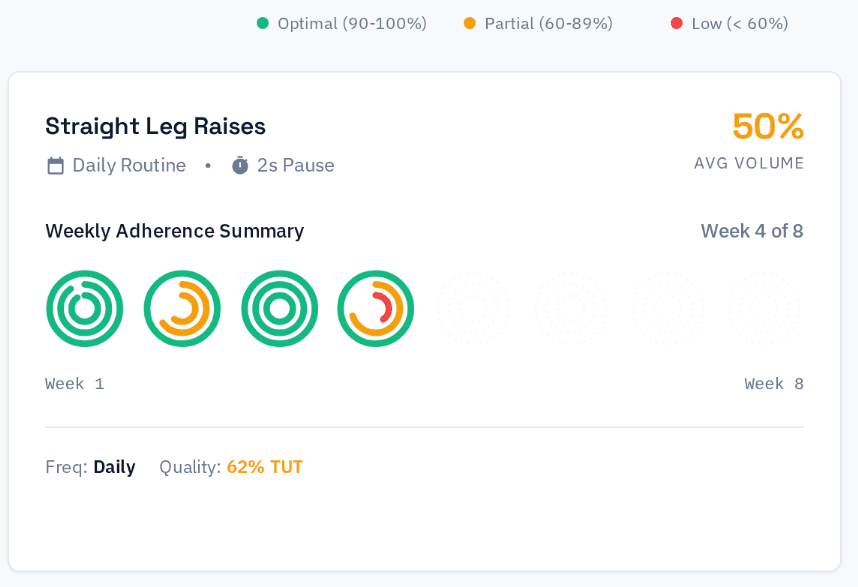
Yderste ring — Sessionsadhærens
Mødte de op? En session tæller som gennemført, når sensoren registrerer mindst en repetition. Det er det tal, de fleste systemer stopper ved — og det skjuler alt derunder.
Midterste ring — Volumenadhærens
Udførte de arbejdet? Sammenligner faktisk gennemførte sæt og gentagelser med ordinationen. En patient med 100 % sessionsadhærens udfører måske kun 82 % af de ordinerede sæt — og dropper volumen i de senere uger, når motivationen aftager.
Inderste ring — Tid under tension
Fik de den fysiologiske dosis? Den mest kritiske metrik. Selv når sæt gennemføres, kan forhastede gentagelser halvere den reelle træningsstimulus. Sensoren måler faktisk tid under tension pr. fase og sammenligner med det ordinerede tempo — og afslører den reelle dosis leveret.
En patient kan se perfekt compliant ud på overfladen, mens vedkommende kun modtager under 40 % af den ordinerede fysiologiske dosis. Tre-rings-visningen afslører gabet — før det underminerer genoptræningen.
Understøtter enhver tempoforskrift
Fysioterapeuten ordinerer enhver kombination. Appen tilpasser metronomen. Sensoren måler resultatet.
| Protokol | Format | Eksempel |
|---|---|---|
| Standard 3-faset | Excentrisk – Hold – Koncentrisk | 3-2-3 |
| Uden isometrisk hold | Excentrisk – Koncentrisk | 4-0-2 |
| Eksplosiv koncentrisk | Excentrisk – Hold – Hurtigt | 3-1-X |
| Kun isometrisk | Statisk hold | 0-30-0 |
| Vægt på excentrisk (senerehab) | Langsom stræk | 6-1-2 |
Tekniske specifikationer
SAMPLINGSFREKVENS
20 Hz
Kapacitiv måling til præcis deformationssporing
KRAFTOMRÅDE
0–50 N
Virker med enhver flad elastik. Kalibreret til Theraband Latex Free.
BATTERILEVETID
40+ timer
Aktiv træningstid. Genoplades via USB-C.
FORBINDELSE
BLE 4.0
Øjeblikkelig, pålidelig app-parring.
Klar til at opgradere din klinik?
Slut dig til fysioterapeuter i hele Norden, der bruger objektive data til at opnå bedre patientresultater.